Lombok Island
Lombok marks an area transition between the flora and fauna of eastern and western Indonesia, first recorded by the British naturalist Alfred Russel Wallace in the last century. By more recent visitors it has often been described as an island waiting to be discovered. Unfairly or not, Lombok is nearly always compared to its 'older and more successful sister', Bali, just a few hours boat ride away over the Wallace Line.
EFFECTS OF THE WALLACE LINE
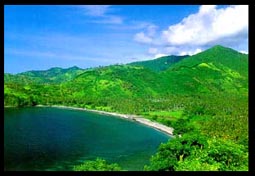 Although Balinese Hinduism has been embraced in West Lombok the two island are as different as chalk and cheese. The Sasaks of Lombok are predominantly Moslem and temples give way to mosques, Particularly in the south and east. The northern part of the island is mountainous and lush with tall trees and shrubs whereas the south is arid, Savannah covered and could easily be a different continent. Large Asian mammals are absent and are replaced instead by marsupials, lizards, cockatoos and parrots. The difference gets even more pronounced the further east one travels with dry seasons getting longer and rice being replaced with corn and sago as the staple food.
soft, snow-white beaches in sheltered blue lagoons are typical in Lombok in Bali'. The island has exceptional charm and considering its proximity to its fabled 'sister' has been spared the influence of bus loads of tourists; for the time being at least.
THE TOYS OF KINGS AND PRINCES
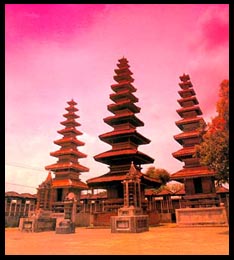 The Matura Palace, or Taman Mayura is one of Lombok's most worthwhile atrractions, second only, perhaps to lounging on a snow-white beach! Located in the small town of Cakranegara, just east of Mataram the island's capital, Taman Mayura is a remarkable construction. Centred by a large spring-fed pond surrounded by a path lined with mangosteen trees it's a superb example of architecture from the reign of King Wayan Taga, who founded the first Balinese dynasty in Lombok in 1741. The gardens has seen many disruptions and changes, including an air-raid in World War Two that destroyed a few structures that were then being used as arsenals.
Fortunately Taman Mayura has received more sympathetic treatment in recent years and it is now a combination of different structures collected over the past two centuries, and 'imported' from other palatial gardens. Several renovation projects have brought the gardens to their original splendour and are a 'must see' when visiting the island.
A NEW KID ON THE BLOCK
Some equally good sights can be found at Senggigi beach, only a half hour away. Senggigi is a small town getting bigger and waiting to show the world what rest and relaxation is all about. Horse drawn carts, bells jingling through the early morning mist, and loaded with produce and passengers are a common sight not only in Senggigi but but over most of the island.
There is more to Lombok than just Senggigi, but it's a great place to start when exploring the island. Other areas of interest are in the southern part of Lombok which, although harder to get to than Senggigi is worth the effort as the beaches are still undeveloped and the countryside pristine.
Design by: Yudi Setiawan
E-mail:
[email protected]
Last updated: November 26, 1997